
Wiley Wilson
He wanted people to meet his pastor

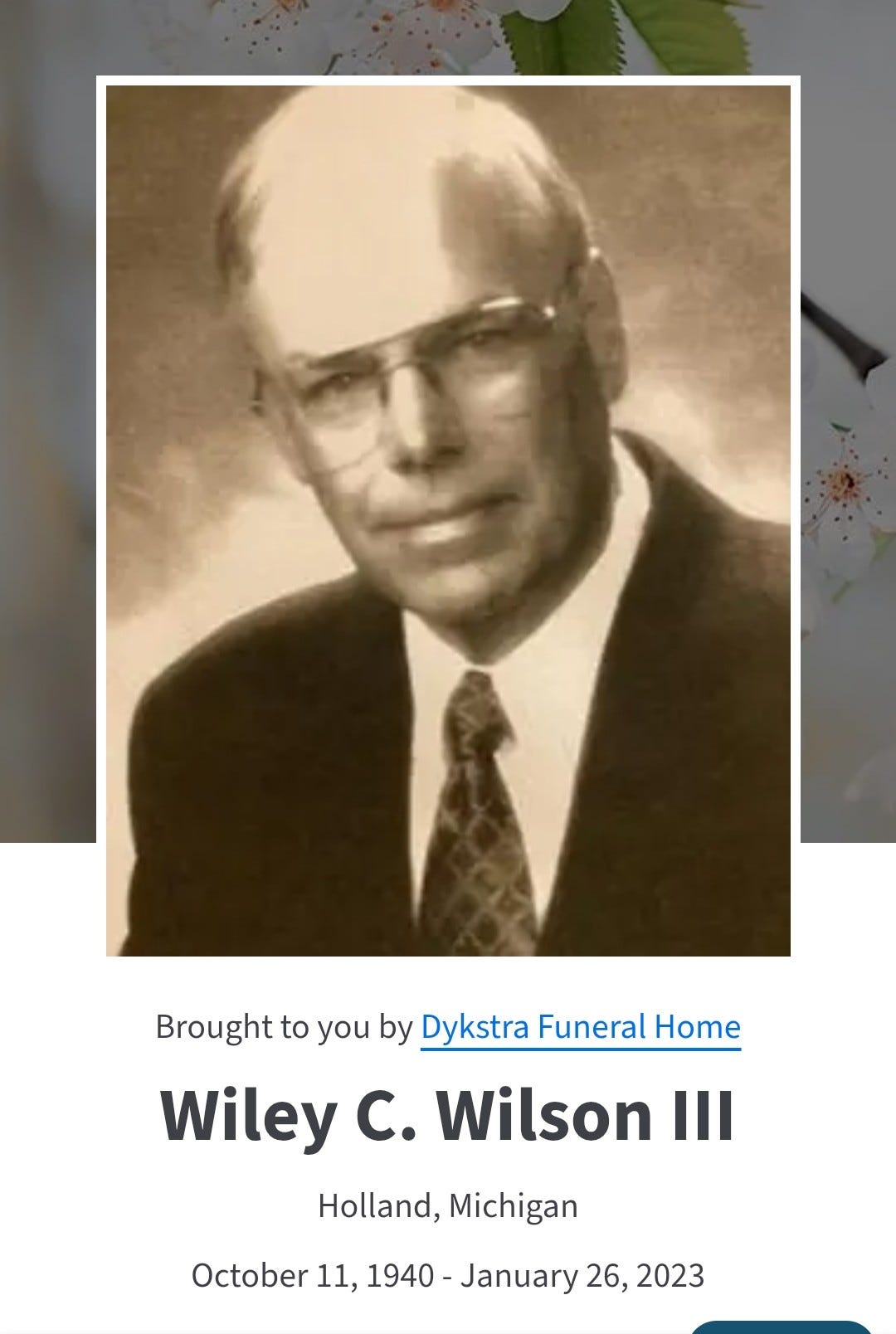
The first time I visited Wiley Wilson, I didn’t want to leave. He was seated in a wheelchair — I never saw him any other way — in a room to himself at the Appledorn Assisted Living Center in Holland, Michigan. Whatever had brought him there, he carried it without complaint and without explanation. What I noticed first, after the wheelchair, was the staff. They kept finding excuses to stop by his room and say hello and ask for his advice. In forty years of pastoral visiting I had seen a lot of assisted living facilities. I had never seen anything quite like that.
Pastors are trained to keep visits brief. The person being visited — either hospitalized or in this case assigned to assisted living — doesn’t have unlimited energy, no matter how glad they might be for the company. I knew this. I had practiced it for forty years. But with Wiley I found myself asking one question, and then another, and then another still. The more he offered, the more curious I became. I don’t remember looking at my watch that first afternoon. I didn’t need to. After forty years I could feel when a visit had run long. This one had. I stayed anyway.
A Life on His Own Terms
Over the months that followed, I learned Wiley’s story piece by piece, the way you learn anyone’s story when the conversation is unhurried and the curiosity is genuine. He had grown up in Nashville. His father was a prominent attorney in the area but had some trouble with the law. Wiley didn’t elaborate about that, and I didn’t ask. What was clear was that he had no use for the man, and what was equally clear was that he had long since made his peace with that. He and his mother moved to the bay area of California when Wiley was seventeen or eighteen. He went to college there, and after graduating he spent a year at San Francisco Theological Seminary.
This was the 1960s, when the seminary was by most accounts a hotbed of activism. Wiley — matter-of-fact, clear-eyed, with firm views about what a pastor should and shouldn’t be — decided it wasn’t for him. He expected pastors to act like pastors. What he found there was something closer to political agitation. He left without apology, taught school for five years, and earned a master’s degree in history. Then he switched gears again, got a business degree, and launched into a long career on the management side of the trucking industry.
Wiley lived for a time in northern New Jersey, where the trucking business had its own particular texture. Organized crime was very much a part of the texture in those years, and Wiley had his brushes with it. He told these stories matter-of-factly, though I could tell he knew they were good ones and that I would be interested. What came through most clearly was his pride in how he had handled those encounters — shrewdly, without flinching, on his own terms. I was not surprised. That was entirely consistent with the man I had come to know.
Holland became home for Wiley and his wife Karen in 1990, and he worked for USF Holland Trucking until his retirement in 2002. In retirement he had been active in HASP, Hope College’s lifelong learning academy — where I am also active — before moving to Appledorn. We discovered at some point that he had lived in Wheaton, Illinois, during the same years I served a church there. We did our best to find overlapping connections but couldn’t. Two men whose paths had almost crossed decades earlier, finally meeting at Appledorn.
His Pastor
I discovered early on that Wiley was a reader. His desk was a card table positioned in his room — books, blank paper, perhaps a laptop. It was the desk of a man who still had things to think about. On one visit, without either of us having mentioned it before, I noticed a copy of my memoir, Chasing After Wind, sitting among his books. He had ordered it, read it, and was ready to discuss it. I found myself more honored by that conversation than by almost any review the book received.
Wiley also arranged, through the activities director at Appledorn, for me to give a talk to the residents about the book. I’m not entirely sure how it came about. What I do know is that Wiley had already sorted it out before mentioning it to me. He wanted, I learned later, for people to meet his pastor.
I was serving a church in The Hague as an interim pastor when an email arrived from Wiley. He mentioned an upcoming surgery. This was unusual — in all our visits he had never once discussed his medical situation, whatever it was that had brought him to Appledorn in the first place. We always had too many other things to talk about. I remember thinking it was odd that he was telling me this. But I was in the middle of a ministry, and news of sick and dying people was part of my daily life. I wrote back something pastoral and well-meaning: I’ll be praying for a good outcome. I sent it without fully understanding what I was responding to.
Only later did it occur to me what Wiley had been doing. He knew — or suspected — that the surgery was serious. He was saying goodbye, in case he didn’t make it. And I had replied with a prayer for a good outcome, not yet understanding that his email was a last communication, and that mine was an unknowing farewell.
Not a Bad Return
I finished my work in The Hague in time to get back for the service at Grace Episcopal Church in Holland. (As it turned out, Wiley had been a member of the Episcopal church in Holland, while his wife was a member of the Presbyterian church.) In forty years I had officiated at hundreds of funerals. I seldom cried during the service itself — there was always the responsibility of holding things together, of being the steady presence at the front of the church. The tears, when they came, usually waited until I got home, until I could sit alone in the den and let them roll.
At Wiley’s funeral I had no such responsibility. I could simply grieve.
His grandson Gabe gave the tribute. I have heard many grandchildren speak at their grandparents’ funerals, and Gabe did a fine job — which is to say, he described the same man I had come to know. That mattered to me more than I expected. Wiley had been exactly who he appeared to be, to everyone who met him. I was relieved to have that confirmed, though I suppose I already knew it.
In the two or three years since Wiley’s death I have been having lunch with his widow, Karen. She was married to Wiley for 59 years, which tells you something about both of them. She grew up in a world where only the husband worked, and so Karen’s considerable gifts found their outlet elsewhere — in the non-profits and civic organizations of Holland, where she served with the same quiet effectiveness that Wiley brought to a card table full of books in an assisted living facility. When the local women’s literary association needed to sell their building, Karen handled it. I have the feeling she could have done Wiley’s job as well as he did, maybe better. He probably knew that too.
What we share over lunch, mostly, are memories of a remarkable man. I went to Appledorn at my pastor’s request, expecting to offer something. I came away with a friend I hadn’t anticipated, a reminder of what I loved most about forty years of ministry, and an ongoing lunch date with his widow.
Not a bad return on a pastoral visit.
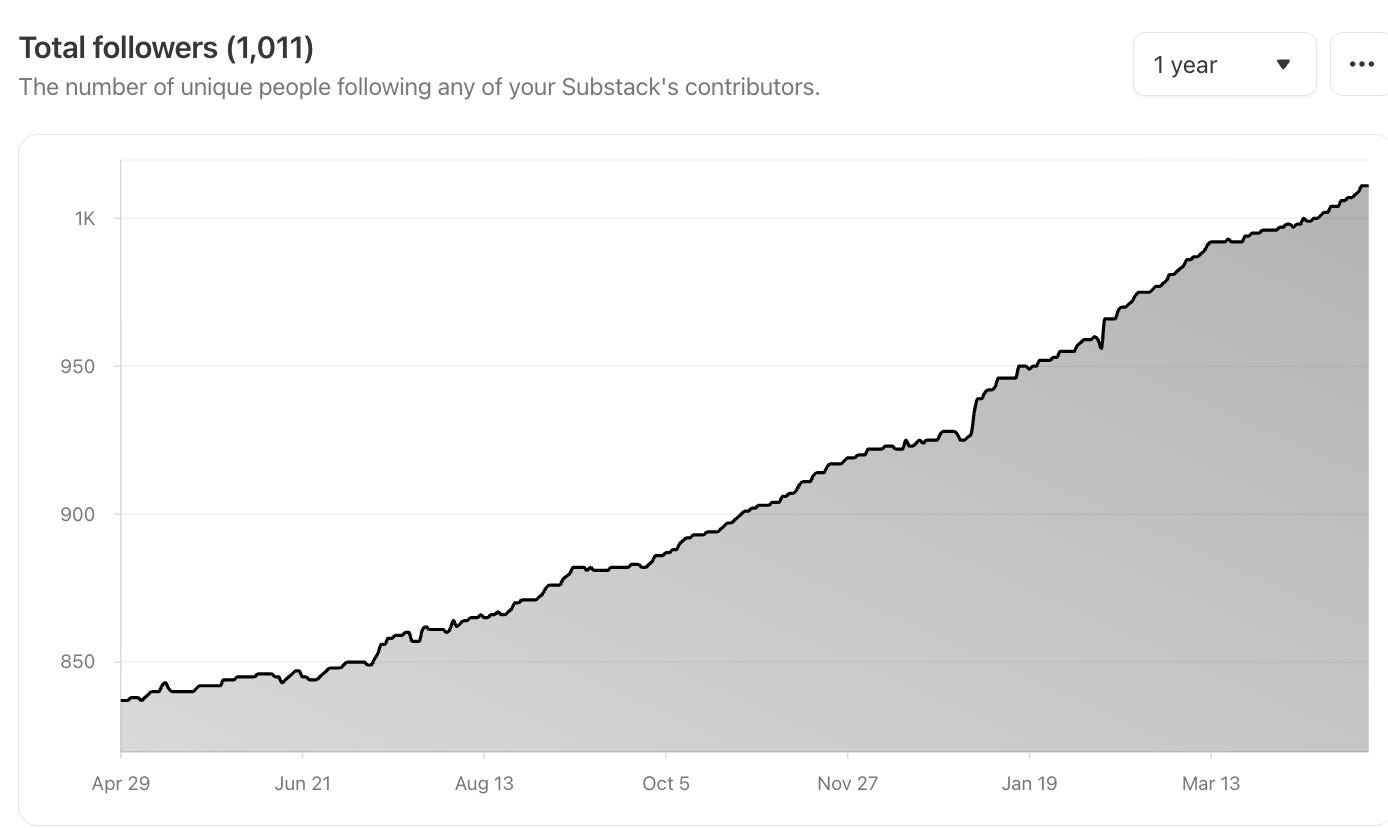
A note of gratitude: As this post goes out, “Musings at the intersection of faith and life” has just passed 1,000 subscribers. I’m grateful for every one of you — for reading, for responding, and for the conversations that sometimes follow. Writing this newsletter has given me far more than I expected.